ps displays information about running processes. It’s essential for monitoring and managing system processes.
Synopsis
ps [OPTIONS]
Common Options
| Option | Description |
|---|
aux | All processes, user-oriented format |
-ef | All processes, full format |
-u USER | Processes for specific user |
-p PID | Specific process by PID |
--forest | Show process tree |
-o FORMAT | Custom output columns |
Examples
Show all processes (BSD style)
$ ps aux
USER       PID %CPU %MEM    VSZ   RSS TTY      STAT START   TIME COMMAND
root         1  0.0  0.1 169592 13092 ?        Ss   Jan15   0:03 /sbin/init
root         2  0.0  0.0      0     0 ?        S    Jan15   0:00 [kthreadd]
greys    12345  0.5  1.2 456789 98765 pts/0    Ss   10:00   0:05 -bash
Show all processes (System V style)
$ ps -ef
UID        PID  PPID  C STIME TTY          TIME CMD
root         1     0  0 Jan15 ?        00:00:03 /sbin/init
greys    12345 12340  0 10:00 pts/0    00:00:05 -bash
Show processes for current user
Show specific process
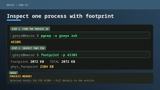
$ ps -p 1234
$ ps -p 1234 -o pid,ppid,cmd,%cpu,%mem
Process tree
$ ps --forest
$ ps auxf    # With forest
$ ps -eo pid,ppid,user,%cpu,%mem,cmd --sort=-%cpu | head
Find process by name
$ ps aux | grep nginx
$ pgrep -a nginx    # Alternative
Understanding ps aux Output
USER       PID %CPU %MEM    VSZ   RSS TTY  STAT START   TIME COMMAND
│          │    │    │       │     │   │    │    │       │    │
│          │    │    │       │     │   │    │    │       │    └─ Command
│          │    │    │       │     │   │    │    │       └─ CPU time
│          │    │    │       │     │   │    │    └─ Start time
│          │    │    │       │     │   │    └─ State (S=sleep, R=running)
│          │    │    │       │     │   └─ Terminal
│          │    │    │       │     └─ Resident memory (KB)
│          │    │    │       └─ Virtual memory (KB)
│          │    │    └─ Memory %
│          │    └─ CPU %
│          └─ Process ID
└─ Owner
Process States (STAT)
| Code | Meaning |
|---|
| R | Running |
| S | Sleeping |
| D | Uninterruptible sleep |
| Z | Zombie |
| T | Stopped |
Tips
- Use pgrep:
pgrep nginx is cleaner than ps aux | grep nginx - Watch processes:
watch -n 1 'ps aux --sort=-%cpu | head' - For real-time: Use
top or htop instead - Find parent: Use
ps -p PID -o ppid= to get parent PID
See Also
- top — Real-time process viewer
- htop — Interactive process viewer
- kill — Send signals to processes
- pgrep — Find processes by name
Tutorials